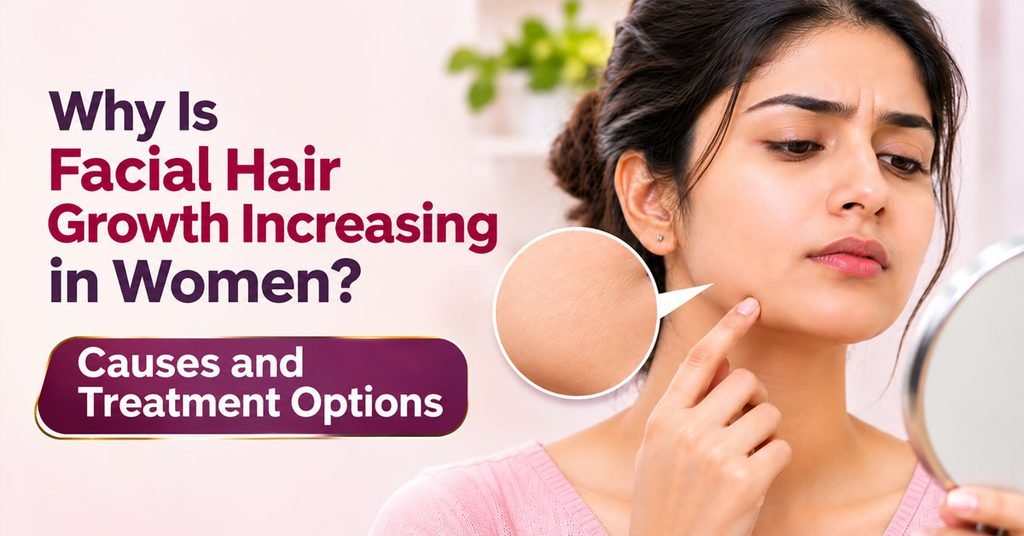
Facial hair growth in women, medically termed hirsutism, develops when androgen levels rise or when hair follicles respond more strongly to normal androgen levels. Polycystic ovary syndrome (PCOS) accounts for most cases, and thyroid disorders, raised prolactin, adrenal conditions, certain medications and menopause account for many of the rest. A hormonal assessment identifies the cause before any treatment begins. Medical therapy controls new growth, while Laser Hair Reduction treats the hair that has already formed. At Aesthetics Skin & Hair Care Clinic Chennai, our dermatologists in Sholinganallur combine both approaches and review progress over several months. The sections below cover the causes, the tests we order, the treatment options and the questions patients ask most often.
What Counts as Excess Facial Hair in Women
Every woman has fine, light vellus hair on the face. Hirsutism refers to coarse, dark terminal hair that grows in a male-pattern distribution, typically on the upper lip, chin, jawline, sideburns and neck. Dermatologists grade it with the modified Ferriman-Gallwey scale, which scores nine body areas. Hirsutism affects an estimated 5 to 10 percent of women worldwide.
Genetics and ethnicity influence how much facial hair a woman considers normal. A gradual increase over months, or growth that arrives with irregular periods and acne, is a different matter and needs evaluation.
Why Facial Hair Growth Is Increasing in Women
Polycystic Ovary Syndrome
PCOS accounts for roughly 70 to 80 percent of hirsutism cases. Insulin resistance stimulates the ovaries to produce more androgens, and weight gain and low physical activity worsen that resistance. Most of the women who consult us for chin and jawline hair also report irregular cycles or acne.
Thyroid, Prolactin and Adrenal Disorders
Hypothyroidism and raised prolactin both disturb ovulation and shift the balance of sex hormones. Non-classic congenital adrenal hyperplasia and Cushing’s syndrome increase adrenal androgen output. These conditions are less common than PCOS, but they require different treatment, so they must be excluded through testing.
Medications and Menopause
Minoxidil, anabolic steroids, danazol and phenytoin can all stimulate facial hair growth. After menopause, estrogen levels fall while androgen activity continues, and many women notice new hair on the chin and upper lip in their fifties.
Sudden, Rapid Growth
Hair that thickens within a few months, particularly with voice deepening or hair loss at the temples, can indicate an androgen-secreting tumour of the ovary or adrenal gland. This pattern calls for urgent investigation.
Hormonal Assessment: What We Test and Why
Treatment without a diagnosis often fails, which is why we begin with a detailed history of your cycles, weight changes, medications and family background. We then order blood tests, timed to the early part of your cycle where it applies.
- Total and free testosterone: identify ovarian or adrenal androgen excess.
- DHEA-S: points to an adrenal source of androgens.
- 17-hydroxyprogesterone: screens for non-classic congenital adrenal hyperplasia.
- Prolactin: detects hyperprolactinaemia.
- TSH: shows thyroid dysfunction.
- LH and FSH: reveal the hormonal pattern seen in PCOS.
- Fasting glucose, insulin and lipid profile: measure insulin resistance and metabolic risk.
- Pelvic ultrasound: assesses polycystic ovarian morphology.
Results guide every decision that follows, from the choice of medication to the number of laser sessions we plan.
Treatment Options for Facial Hair in Women
Medical Therapy
Combined oral contraceptives lower ovarian androgen production, and spironolactone blocks androgen receptors at the follicle. Metformin helps when insulin resistance drives the condition. These medicines work slowly. Visible reduction in new growth usually takes six months, and we do not prescribe spironolactone to women who are pregnant or planning pregnancy.
Topical and Cosmetic Methods
Eflornithine cream slows hair growth when applied twice daily, though it does not remove existing hair. Threading, waxing and plucking clear hair temporarily and cause irritation in some patients. Shaving does not alter the thickness or rate of growth.
Laser Treatment
Laser energy targets melanin in the hair shaft and follicle, and it damages the follicle enough to reduce regrowth. A Long-Pulsed Laser delivers energy over a longer pulse duration, which penetrates deeper and lowers the risk of epidermal injury in darker skin. This makes it a common choice for the skin specialist in Chennai.
Facial areas usually need six to eight sessions spaced four to six weeks apart. Hormone-driven hair continues to recruit new follicles, so most patients return for maintenance sessions once or twice a year.
Why Hormonal Assessment Comes Before Laser
A patient who treats the hair without treating the hormones usually sees regrowth within months, and the sessions already paid for lose their value. We therefore sequence care in a fixed order: assessment first, medical control second and laser third. Your results also determine your starting settings.
Before your first session, we ask you to follow these steps:
- Avoid waxing, threading and plucking for four weeks, because the laser needs the hair root intact.
- Shave the treatment area one day before the appointment.
- Stay out of direct sun for two weeks before and after each session.
- Complete a patch test, which allows us to check your skin response at the settings we plan to use.
Conclusion
Facial hair growth in women has a medical cause that can be identified, and the treatment plan depends on what the tests show. Our team at Aesthetics Skin & Hair Care Clinic Chennai evaluates your hormones, prescribes medical therapy where it is needed and selects the laser platform after assessing your skin type and hair thickness. A Diode Laser is one of the options we use for facial hair, and we choose it only when your skin and hair characteristics suit it. Book a consultation with us to start with a hormonal assessment.
Frequently Asked Questions
Is facial hair in women always a sign of a hormonal problem?
No. Family history and ethnicity account for some cases. Growth that increases over time, or appears alongside irregular periods, acne or weight gain, warrants a hormonal assessment.
Which hormones are tested for excess facial hair?
We test total and free testosterone, DHEA-S, 17-hydroxyprogesterone, prolactin, TSH, LH and FSH, along with fasting glucose and insulin. A pelvic ultrasound completes the workup when PCOS is suspected.
Can PCOS-related facial hair be reversed?
Medical therapy reduces new growth, and most patients see improvement after six to twelve months. Hair that has already formed remains until it is removed, and laser is the usual method for that.
Does shaving or waxing make facial hair grow thicker?
No. Clinical evidence shows that neither method changes thickness or growth rate. Shaved hair feels coarser because the tip has a blunt edge.
How many laser sessions are needed for facial hair?
Most patients need six to eight sessions spaced four to six weeks apart. The exact number depends on hair density, skin type and hormone control.
Is laser treatment safe for Indian skin?
Yes, when the device, pulse duration and energy are matched to your skin type. We perform a patch test first, and we advise strict sun protection afterwards to prevent pigmentation changes.
When should I see a doctor urgently?
Rapid growth over a few months, deepening of the voice, scalp hair loss at the temples or missed periods should prompt an evaluation without delay.