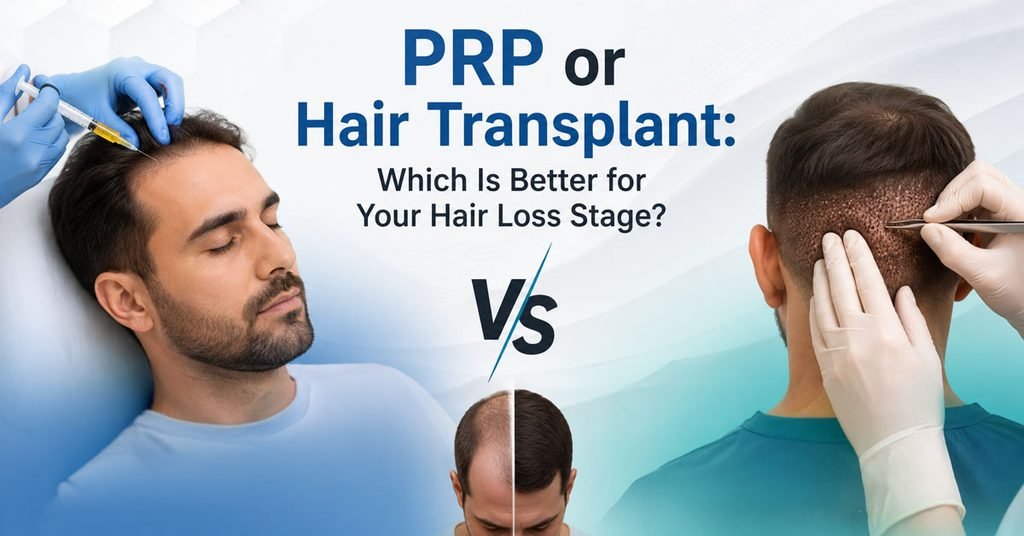
Noticing more hair in your comb or watching your hairline retreat raises an immediate question: how do you fix it before it gets worse? The hair restoration market offers dozens of remedies, but two medical treatments stand out for producing genuine results: a plasma rich protein hair treatment and hair follicle surgery.
Understanding what each treatment actually does and how they differ is the first step toward reclaiming your hair density.
What Is a Plasma Rich Protein Hair Treatment?
Plasma rich protein hair treatment is a non-surgical regenerative procedure that helps in rejuvenating weak or miniaturized hair roots.
A small blood sample is drawn and processed in a centrifuge to isolate platelets, which carry growth factors that support cell repair and tissue regeneration. This concentrated plasma is then injected into areas of the scalp showing signs of thinning.
Rather than adding new hair, PRP works on existing follicles, supplying them with concentrated growth factors. It improves blood flow at the root, strengthens individual hair shafts, and reduces active shedding, without incisions or recovery time.
Most patients tolerate the injections well; a numbing cream is typically applied beforehand, and no additional anesthesia is required. A full course usually spans several sessions over a period of weeks, with visible improvement building gradually, often becoming noticeable after the second or third session.
What Is Hair Follicle Surgery?
Hair follicle surgery, commonly known as a hair transplant, is an outpatient surgical procedure designed to restore hair in areas where growth has completely stopped.
In this process, healthy, genetically resilient roots of hair are removed from a donor site (usually the back or sides of your head) where hair is naturally resistant to balding and then carefully implanted into micro-incisions created in the balding or receded areas of the scalp.
Unlike non-surgical options that attempt to revive weak roots, hair follicle surgery physically moves working follicles to bare areas. Once these transplanted roots take hold, they continue to grow natural, permanent hair for a lifetime.
The procedure generally takes several hours, depending on the number of grafts, and is completed on an outpatient basis. Transplanted hair sheds within the first few weeks before new growth begins, a normal and expected part of the healing process. Visible regrowth typically starts within a few months, with final results developing over roughly a year.
Where Does Your Scalp Stand Right Now?
Neither treatment is universally superior; the right choice depends on where your hair loss currently stands. For anyone considering a hair treatment in Chennai, matching the stage of hair loss to the appropriate procedure helps avoid unnecessary cost and delay.
Hair loss rarely happens all at once. It progresses thru various phases, generally assessed with standard clinical scales such as Norwood (for men) or Ludwig (for women):
- Initial Thinning: You might notice a slight recession at the temples or a slight widening thru your middle part. The roots are alive here, but the strands they make are getting thinner and weaker as time goes on.
- Moderate Loss: The scalp becomes visible under direct light. The hairline forms an odd M shape or the crown is thinning. Some of the roots are pulling back quickly but many are still alive.
- Advanced Baldness: Specific patches become smooth with no visible hair. When a section of the scalp reaches this point, the roots beneath have fully shut down. Once a follicle dies, non-surgical methods can no longer bring it back.
For patients in the early thinning stage, starting with a plasma rich protein hair treatment is generally the more conservative option before considering surgical intervention.
PRP vs. Hair Transplant
| Factor | Plasma Rich Protein Hair Treatment | Hair Follicle Surgery |
| Method | Quick clinic injections | Outpatient surgical placement |
| Best Stage | Early to mid-stage thinning | Advanced loss & bare patches |
| Core Goal | Thickens existing hair & stops shedding | Fills in empty, bald areas |
| Downtime | None; resume work immediately | A few days for scalp healing |
| Session Model | Initial series + periodic maintenance | Single procedure with long-term results |
Why Addressing the Underlying Cause Matters
Selecting a procedure is a secondary decision; identifying and managing the underlying cause of hair loss comes first.
In cases of androgenetic alopecia (pattern hair loss), surgery alone is not a complete solution. A transplant relocates existing follicles but does not halt the ongoing loss process. Left untreated, the surrounding non-transplanted hair can continue to thin, affecting the overall outcome over time.
Treatments such as PRP, medications, or other hair restoration therapies help slow down hair loss and preserve your density. A hair transplant is generally recommended once hair loss is significant and permanent, and sufficient donor hair is available.
Clinically, the strongest outcomes tend to follow a defined sequence: manage the underlying cause, stabilize the hair loss, then proceed with a transplant if still required.
Additional treatments used to stabilize hair loss and support density include:
- GFC (Growth Factor Concentrate)
- Exosome therapy
- Dutasteride therapy
- Microneedling, including with hair peptides such as copper tripeptide
- Hair LED therapy
- PRF (Platelet-Rich Fibrin)
A dermatologist can determine which of these, if any, is appropriate for a given case.
Can You Do Both?
Dermatologists often combine these protocols. Performing hair follicle surgery fills in empty zones, while subsequent plasma rich protein hair treatment sessions help speed up healing and keep your surrounding natural hair dense and healthy. This combination approach tends to work particularly well for people who have both an established bald patch and visible thinning around it, addressing the dead zone surgically while reinforcing the weaker, still-living follicles nearby through PRP. It’s not the right fit for everyone, but for the right candidate, it often delivers a more complete, natural-looking result than either treatment alone.
Why Book Your Evaluation at Akshaya Skin Clinic?
A clear treatment plan requires a proper clinical evaluation of the scalp and hair roots, not a standard package. At Akshaya Skin Clinic, each consultation begins with an assessment of follicle health to determine the appropriate course of action.
- Tailored Treatment: Plans are based on the condition of your follicles, not fixed treatment bundles.
- Established Methods: Whether through plasma rich protein hair treatment or hair follicle surgery, the objective is natural growth patterns and density.
- Clear Assessment: You receive a clear recommendation on whether plasma rich protein hair treatment can stabilize your hair loss, or whether hair follicle surgery is the appropriate next step.
Taking the Right Step for Your Hair
At the end of the day, the right choice comes down to where your hair loss stands right now. Early thinning usually responds well to plasma therapy, while smooth, bald areas need fresh grafts to grow hair again. Armed with this knowledge of what your scalp can achieve you will be able to make an informed decision that will result in real, lasting results when you consult with an experienced Dermatologist Specialist in Chennai.
Reach out to Akshaya Skin Clinic to book your initial evaluation and find out which approach fits your hair best.